


Audience Measurement Explained: How ECN calculates its DOOH office audience
Intro
Audience measurement in digital out-of-home (DOOH) is critical for transparency, accountability, and comparability with other digital channels. Executive Channel Network (ECN) applies a clear, data-driven methodology to measure its audience across premium office buildings in the UK, France, and Germany.
Unlike public DOOH environments such as transport hubs or shopping centres, where audience estimates can rely on broad mobility models and generalised traffic data, ECN measures audiences in private, controlled indoor environments. These spaces, such as reception foyers and elevator lobbies, have their own unique audience dynamics.
Understanding them requires a far more granular and precise measurement process.
ECN’s two-step approach combines real building occupancy data from property owners with independent mobility validation using GDPR-compliant Wi-Fi and sensor-based technology from BlueZoo. This ensures every impression is grounded in verified human presence and movement, not assumptions. The result? Impressions that are transparent, accurate, and meaningful, they give planners confidence that their campaigns are being delivered to real, valuable business audiences.
Why audience measurement is critical in DOOH
In today’s performance-driven media environment, planners and advertisers need more than estimated reach. They need reliable data that shows:
– Who is being reached
– Where they are reached
– How long they engage with the message.
Reliable measurement provides the foundation for planning, buying, and attributing DOOH alongside other digital channels. Without robust audience data, advertisers risk wastage, inefficiency, and campaigns that cannot be justified in cross-channel ROI reporting.
ECN’s methodology turns office-based DOOH into a fully accountable, impression-based medium, one that speaks the same language as online video, connected TV, and digital display.
How different OOH markets measure audiences
Audience measurement frameworks differ across Europe:
– United Kingdom – Route: The UK’s industry standard, jointly owned by buy and sell-side of the OOH industry. Route uses national travel surveys, GPS data, and visibility models to estimate exposure in public spaces.
– Germany – iDOOH: The German DOOH industry body that provides standardized audience metrics for both public and private screen networks.
– France – Mobimetrie: The official audience measurement body measures DOOH markets.
Despite these regional variations, ECN uses one consistent methodology across all markets, combining:
– Verified building occupancy data from landlords, and
– Independent Wi-Fi mobility validation via BlueZoo.
This uniformity allows ECN to offer cross-market comparability and harmonised reporting – a valuable advantage for international brands and programmatic buyers seeking consistency.
The ECN audience
ECN delivers access to a premium, hard-to-reach business audience across Europe’s key commercial hubs.
It includes:
– Decision-makers – C-Suite executives, managers, and senior professionals.
– Affluent consumers – high earners with above-average disposable income.
– Dual-role influence – professionals shaping both business purchases and personal lifestyle choices.
This makes office DOOH one of the few media environments where B2B and B2C influence overlap naturally.
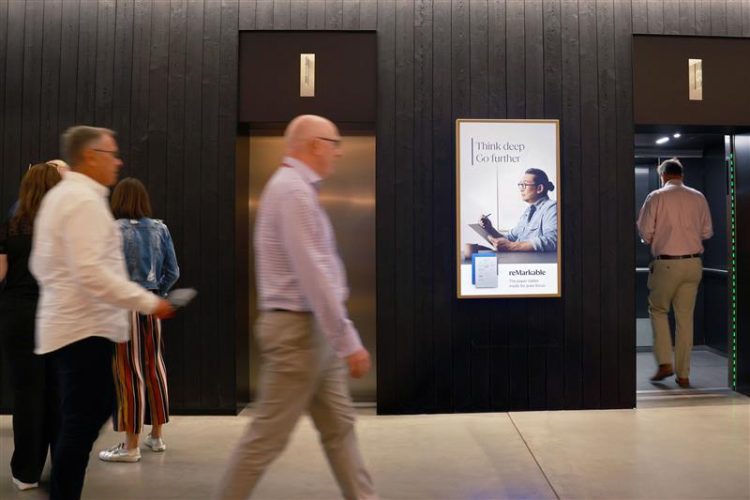
Why measuring audiences in private office environments is more complex
Public DOOH environments – such as roadside billboards, train stations, or airports – often use journey modelling and traffic datasets to estimate exposure. These rely on predictable travel flows, anonymised GPS data, or census-derived averages.
Office environments, however, are private, access-controlled ecosystems, where:
– Movement is shaped by professional routines rather than public travel.
– Entry is restricted to employees, tenants, and registered visitors.
– Dwell-times are longer and more predictable.
– Exposure frequency is repetitive, the same professionals visit the same building each weekday.
This means audience measurement cannot rely on generalised mobility data. Instead, it must be built from real building-level activity.
For ECN, this complexity is a strength. Because offices are structured, consistent spaces, the resulting data is cleaner, more deterministic, and highly predictive. When verified by live mobility validation, ECN’s data represents true audience behaviour, not inferred exposure.
The Office Audience & their behavioural rhythms
Most OOH audience measurement systems refresh data only a few times per year, however ECN’s audience data reflects real-world human activity..
Because ECN monitors movement continuously, it detects fluctuations caused by:
– Public holidays and long weekends
– Seasonal work patterns (summer holidays, Christmas slowdown)
– Special events or weather impacts (for example, heavy snow reducing office attendance)
This means ECN’s audience numbers are always current, responsive, and dynamic, enabling smarter trading and better campaign optimisation.
To provide complete transparency, ECN’s real-world audience dashboard, gives advertisers and planners live visibility of building-level impressions across its network.
For advertisers, the benefits are tangible:
– Precision pricing that reflects audience footfall.
– Optimised scheduling during audience peaks.
– Real-time impression data for programmatic buying and post-campaign reporting.
ECN’s network effectively functions as a live audience barometer, monitoring footfall 24×7 and ensuring that every impression traded, whether traditional or programmatic, reflects real people in real time.
The Daily Rhythm of the Office Audience
Measuring office audiences is not as simple as counting commuters. It’s about understanding a daily rhythm that shifts subtly hour by hour, week by week, and month by month.
From the moment an employee swipes their building pass in the morning to the moment they leave after work, office environments pulse with distinct audience patterns.
Morning arrival peaks (07:30–10:00)
As professionals arrive at work, building foyers and lift lobbies experience sharp spikes in footfall. These are high-attention moments – people are alert, transitioning into work mode, and mentally engaged with their surroundings. ECN’s screens capture this traffic surge with precision, showing when and how audiences concentrate.
Midday and lunchtime (12:00–14:00)
People are alert, in work mode, and mentally engaged with their surroundings. Footfall rises again as people step out for meetings or lunch. The atmosphere is more relaxed, social, and receptive – ideal for brand storytelling. Audience measurement during this period shows extended dwell-times in receptions and communal areas, translating to longer viewing opportunities.
Afternoon stability (14:00–17:30)
Footfall stabilises, often corresponding to building-wide occupancy levels. ECN’s data identifies the steady cadence of in-building circulation – visitors arriving, couriers, clients, and staff moving between meetings.
Evening departures (17:30–19:00)
A final mini-peak occurs as employees leave for the day. Unlike transport DOOH, which captures transient audiences, ECN’s network engages audiences who are still mentally “switched on”, often checking phones or waiting for colleagues.
Over a week, this creates a predictable yet varied rhythm, repeating with subtle differences that depend on sector, building type, and tenant profile. For example, tech hubs might show longer days and later peaks, while financial institutions see earlier surges.
The Yearly Rhythm – Real People, Real Patterns
Office audiences also follow annual rhythms that reflect real business behaviour:
– Public holidays and bank weekends naturally reduce office footfall.
– Summer holidays, especially in continental Europe, cause gradual declines as professionals take time off.
– Christmas and year-end bring a sharp but predictable dip in traffic, followed by a fast recovery in January.
– Spring and autumn months tend to show the highest and most consistent audience volumes, aligning with peak business activity periods.
These fluctuations are not theoretical, ECN’s audience data captures them as they happen. Each movement, absence, or seasonal lull is reflected in the network’s real-time data flow.
This level of granularity allows ECN to produce real-world audience data that mirrors the true rhythm of business life – something traditional OOH measurement systems, often updated biannually or annually, simply cannot achieve.
ECN office DOOH audience measurement
ECN applies a two-step measurement process that combines building-level occupancy data with independent mobility and dwell-time validation.
Step 1 – Building Occupancy & Flow Data
Data is sourced directly from property managers and landlords across ECN’s network of premium offices in the UK, France, and Germany. This includes:
– Building size – The Net Lettable Area (NLA) of the actual office, measured in square metres or feet.
– Permanent tenants – The estimated number of professionals who work full-time in the building.
– Visitors and contractors – Additional individuals entering for meetings or services.
This forms the base layer of ECN’s audience model, a true reflection of the professional ecosystem within each building.
Step 2 – Independent Mobility & Dwell-Time Validation
ECN partners with BlueZoo, a GDPR-compliant mobility analytics specialist, to validate occupancy profiles using anonymised Wi-Fi and sensor-based data. The system tracks:
– Flow mapping: How people move across receptions and lobbies.
– Temporal patterns: Audience changes by time of day, day of week, and season.
– Dwell duration: Seconds of viewability per screen location.
– Frequency modelling: How often individuals are likely to encounter the screen weekly.
Together, these steps deliver a complete picture of who is present, when they are present, and how long they engage – all verified through live, anonymised data streams.

The ECN methodology in practice
– Proven verification: ECN data aligns with industry studies such as the iDOOH Germany.
– Precision pricing: Live data ensures audience estimates match real occupancy patterns.
– Digital integration: Impression-based reporting aligns seamlessly with ad-tech standards.
– Transparency: All collection and analysis comply with GDPR and privacy-by-design principles.
Case Study: iDOOH Germany Validation
Objective: iDOOH, the German DOOH industry body, wanted to validate office dwell-times within its Public and Private Screens Study.
Approach: ECN supplied anonymised mobility data (via BlueZoo) across a representative sample of German offices. iDOOH compared ECN’s dataset with a separate independent survey sample.
Outcome: The two datasets were perfectly aligned. iDOOH officially verified ECN’s methodology, integrating it into Germany’s national DOOH benchmark, proof of ECN’s credibility and precision.
How can planners use ECN’s audience data in practice?
– Cross-channel planning – Integrate verified office impressions into digital and video plans.
– Programmatic optimisation – Activate campaigns dynamically based on real building data.
– Attribution modelling – Link impressions with brand lift or sales metrics.
– ABM alignment – Target offices housing priority client accounts.
This turns office DOOH into an accountable, data-enriched medium that connects seamlessly with the wider digital ecosystem.
Conclusion
Measuring office audiences is complex, shaped by daily movement, seasonal rhythms, and professional behaviours. ECN captures this complexity with precision. By combining building-level occupancy data and continuous Wi-Fi-based validation, ECN tracks real-world human movement. Audience data adjusts dynamically to public holidays, commuter peaks, and even seasonal slowdowns, providing advertisers with the most current, transparent picture of exposure possible. Because ECN applies this same consistent methodology across the UK, France, and Germany, planners can compare and optimise campaigns with total confidence, whether trading traditionally or programmatically.
Campaigns measured through ECN’s methodology consistently deliver double-digit uplifts in awareness, recall, and retail impact compared to traditional DOOH.
Download the 2-Step ECN Audience Measurement Guide.
FAQs
How often is ECN’s audience data updated?
Mobility data is monitored 24×7 and updated regularly to reflect real-world occupancy and movement. Quarterly reporting cycles ensure planners always have access to current, seasonally adjusted data.
What makes ECN’s measurement approach different from other DOOH networks?
ECN combines deterministic building occupancy data with third-party mobility validation, rather than relying on static or modelled datasets.
How does ECN ensure privacy and GDPR compliance?
All device signals are anonymised and aggregated before analysis. No personal or identifiable data is collected or stored.
Is audience data available by building or region?
Yes. ECN provides audience data by building, cluster, or city, allowing for precise, data-led targeting.